Posts Tagged ‘fear of emotional closeness’

How to Get Close Again Without Using Threats

August 4th, 2015 Comments Off on How to Get Close Again Without Using Threats


INSIGHT AND ADVICE ON THE FEAR OF EMOTIONAL INTIMACY AND HOW TO MANAGE IT

overcoming the fear of emotional intimacy


You are longing for your partner to notice that you feel left out and useless in the relationship.

But your partner only sees what they do for you and how little you reciprocate.

You become morose to get your partner to worry, but all you get is words of disapproval that you aren't pulling your weight.

Your partner feels burdened and gets upset at you.

Both of you have hit a wall.

Neither of you can see a way through it or over it.

You both want to hold hands again and remove that wall separating you, but there is no closeness

You can't function properly while you are feeling so unimportant

You keep banging your head against the wall hoping it will bleed and make your partner feel guilty, bash down the wall and tend to you.

Your partner is finding it increasingly challenging to maintain juggle all the balls in the air, fantasizing about being emotionally intimate with you

Both of you get crabby and irritable without the soothing experience of emotional closeness

You can't take the pressure any more and make a threat – "I'm not going to your brother's party this weekend!"

Your partner counters with another threat, " I'm taking the car for a week when I go camping with my parents"

Overwhelmed with a sense of abandonment you and your partner make the wall higher and deeper.

More threats are needed to force one or other to climb over the top, or dig a tunnel underneath.

Because what you are both aching for is the comfort of emotional intimacy without the fear that you are giving up ground, or losing face.

In this video I tell the story of Tasha and Johnie who felt they were up against a wall that just kept getting taller and wider. I describe how I helped them in couples therapy to  take the risk of removing a brick here and there to make a tentative connection through mutual understanding.

They found their way back to an emotionally close place where threats were no longer the weapon of choice.

You can do it too, if you watch and use the same strategies.


copyright, Jeanette Raymond, Ph.D. 2015


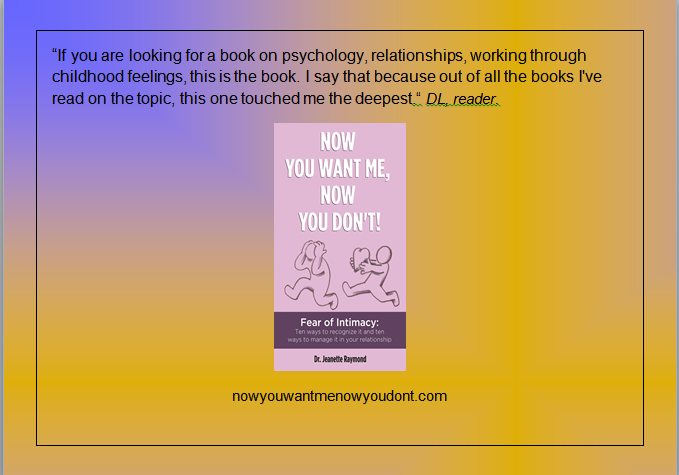
Author of: Now You Want Me, Now You Don't! Fear of Intimacy: Ten ways to recognize it and ten ways to manage it in your relationship

" Thanks a million for writing this book. To my knowledge, it is the best book on the market on this subject. No other book I have read gives you an inside into the dynamics both partners apply in a relationship where commitment fear is at play. Anyone in such a relationship knows about the trauma, pain and hopelessness. This book showed me where I go wrong and what I do to trigger my partner’s behaviour. It gave me a real inside in what my partner feels in moments when everything escalates and how I contribute to it. It also gave me extremely good guidance what I can do to break this unhealthy cycle. What I liked most is that this book does not stigmatise people with this problem and it does not tell you to leave your partner – like most books on this subject do. The experience of Dr Raymond really shows – this book was written to help you; and that is exactly what it did for me. I am so glad this book exists. "  Regina E.


 You might also like:

Three ways to control rage when you feel abandoned

Is sex after a fight your way of avoiding emotional intimacy

Pressing the refresh button on a crumbling marriage


Disclaimer: this article is for informational and educative purposes only. Dr. Raymond is not responsible for any reactions you may have when reading the content or using the suggestions therein. Interacting with this material does not constitute a therapeutic relationship with Dr. Jeanette Raymond


Is Your Empathy Style Making You Afraid of Emotional Intimacy?

June 30th, 2015 Comments Off on Is Your Empathy Style Making You Afraid of Emotional Intimacy?

INSIGHT AND ADVICE ON THE FEAR OF EMOTIONAL INTIMACY AND HOW TO MANAGE IT


Now You Want Me, Now You Don't! Fear of Intimacy book

For the last ten minutes 33-year-old Hunter explained his frustration with having to be 31year-old Cloe’s caretaker, but she didn’t get it. No matter how often he shared his discomfort with having to worry about Cloe being on her own without friends or hobbies, she kept responding with the same phrase: “I get it, but I’m fine as I am. You don’t need to worry about me!”

This stock answer infuriated Hunter who found himself in a romantic relationship that seemed more like being a single parent than a partner! Cloe’s constant text’s and calls when he was away on business or playing in tennis tournaments, made it obvious that she wasn’t “fine” and needed constant reassurance that he was thinking of and missing her. One part of him felt guilty that he wasn’t with her while another part of him was glad to escape.

Longing to be his special one, Cloe felt put aside and unwanted. When Hunter spent time away from her and didn’t stay in touch with ongoing text messages and calls to check in she felt he preferred other people. She tried to make him see that her need for closeness was the essence of romantic relationships, and that he was lacking in that respect. Although he said he ‘got it’ and would try harder, she experienced it as paying lip service, just to end the discussion. All too soon he would tell her that he “couldn’t breathe” and that she needed to get a life outside of him. Hurt by his remarks, she felt misunderstood and frustrated.

So how come Cloe and Hunter are both feeling so frustrated about not getting through to one and other? Why are they both feeling so unseen and unfelt?

cognitive empathy v affective intimacy

It’s all to do with getting empathy, but not the right sort.

When Hunter tells Cloe about not being able to breathe he wants her to sense his experience of being choked, understand it by recalling times when she has felt choked and then understand where he’s coming from. He wants affective (emotional) empathy .

But what he gets is cognitive (intellectual) empathy and that isn’t nearly as satisfying. Yes, Cloe ‘gets it’ – she registers that he is uncomfortable and blames her, but she isn’t validating his pain. He is receiving cognitive empathy which is totally unsatisfying.

Same for Cloe- she wanted Hunter to feel the pain of her longing, by referring back to a time when he longed to be close to someone and couldn’t – she wanted him to know that suffering and put his arms around her, hold and comfort her, while enjoying that intimate moment and creating more. She wanted affective empathy, but what she got was cognitive empathy – very disappointing and demoralizing. He said he ‘understood’ but it was just recognition that she had a need he wasn’t fulfilling. He didn’t really get her pain and suffering.

A recent study published in NeuroImage, 2015, found higher density of grey matter in different brain areas according to the type of empathy that was being felt for another. Those who had higher levels of affective (emotional) empathy, had more grey matter in the insula, found in the middle of the brain. Cognitive empathy high scorers had more grey matter in the midcingulate cortex, an area just above the corpus callosum which connects the left and right hemispheres.

When both partners in a romantic relationship are better at cognitive than affective empathy the result is often deep disappointment, and hopelessness that their will ever be that feeling of true connection, acceptance and union.


affective empathy reduces fear of intimacy


For empathy to be truly effective, all parts have to work in unison.

There has to be an intellectual recognition of what is going on for the other person, where they are coming from and what they are trying to tell you.

AND there has to be the affective piece – where you identify and emotionally experience similar feelings. It’s a deeper level of understanding and one that is absolutely necessary for relationship satisfaction.

Hunter and Cloe excelled in cognitive empathy because they got by in life that way. It was safe. It meant they could have some connections with important people in their lives, but not be vulnerable to the vagaries of emotions that may be difficult to control. They avoided feeling weak and easy to con. They had grown up with a defense against emotional intimacy by honing their cognitive empathy skills to the detriment of the affective side and were dealing with the consequences in a frustrating and unsatisfying relationship.

But it doesn’t have to be that way. They don’t need to let fear of emotional intimacy control them forever. Both can learn how to tune into their partners and bulk up the grey matter in the insula parts of their brain. They do that in therapy, where they receive affective empathy, grow it in themselves and then offer it to each other. Without the firsthand experience of affective empathy in a safe and nurturing therapeutic setting, the affective empathy parts of their brains are unlikely to be developed to their full potential.

 
 copyright, Jeanette Raymond, Ph.D. 2015


Author of: Now You Want Me, Now You Don't! Fear of Intimacy: Ten ways to recognize it and ten ways to manage it in your relationship


 You might also like:

 Four ways to share feelings and be empathic

The second secret to being empathic and boosting your relationship

The secret ingredients for empathy in relationships – part 3


Disclaimer: this article is for informational and educative purposes only. Dr. Raymond is not responsible for any reactions you may have when reading the content or using the suggestions therein. Interacting with this material does not constitute a therapeutic relationship with Dr. Jeanette Raymond


Fear of Intimacy Ruined an Engagement and the Hope of a Long Term Relationship

April 10th, 2015 Comments Off on Fear of Intimacy Ruined an Engagement and the Hope of a Long Term Relationship


INSIGHT AND ADVICE ON THE FEAR OF EMOTIONAL INTIMACY AND HOW TO MANAGE IT

Now You Want Me, Now You Don't!. Fear of Intimacy book.

Tracy, a thirty-three-year-old web designer longed to settle down with a good man, get her family to bond with his, and then have children. She had found decent men in the past, but they didn’t want to settle down in the time frame she had in mind. Other men had been acceptable but had addictions outside the relationship that made them emotionally unavailable to her. So she went in and out of romantic liaisons, hoping to find the right match. They were both safe, because she didn’t have to invest in them and then end up devastated down the road.


As Soon As Things Looked Perfect Tracy Became Uncomfortable

But now she was in love with thirty-five-year-old Phil who seemed to want what she wanted – the family life, a faith that was important to both of them, and strong ties to their families of origin. Everything looked good until she stayed with his family while Phil was away on a work assignment. She heard about his ex-girlfriend and how close they had been. In fact she was still a family friend. The idea of it made Tracy uncomfortable. She was also uneasy about the way Phil eased right back into the closeness with his mother on his return. His attempts to resume emotional intimacy with her felt wrong! How could he be close with his mother and her? How could he be good friends with his ex while romantically involved with her?


Now You Want Me, Now You Don't! Fear of Intimacy book.


Red flags went up and she took note.

Tracy just didn’t feel safe. She stepped away from the relationship to protect herself against what she felt was a betrayal. In her eyes, Phil could only be ‘giving himself’ to one person at any one time. If she was his woman then he couldn’t be close with anyone else for any reason.

But Phil and Tracy had strong feelings for one another. They got engaged and started planning a wedding. Everything was going great, and that made Tracy happy but terrified. She was hurtling along into a union where she was going to be investing her whole being. She felt vulnerable and unsafe again. Focusing her anxiety on investigating Phil’s spending on credit cards she discovered that during a hiatus in their relationship, he had sent flowers and booked a weekend getaway for two! That was all she needed to see ANOTHER RED FLAG.

She broke off the engagement and suffered with many tears of sorrow, feeling let down and unable to trust Phil. But she felt safe.

Closeness and intimacy were existential threats to Tracy. Each time she came to the brink of having to ‘give herself’ completely to another she felt unsafe and found reasons why the guy wasn’t the right one.

Fear of intimacy was the key threat to her personal integrity. She couldn’t invest everything because it would mean living with unpredictability, no guarantees and unknown risks. Better to dig and find something, anything that she could legitimately use as a reason to back off.

But Tracy cried and cried out of loneliness.

She couldn’t trust the world to be solid under her feet.

Tracy is now stepping in and out of therapy because she knows there is a pattern to her behavior where she destroys potential joy in order to hold onto the reins of safety. She feels she gets in her own way, but isn’t sure how to move out of this fearful place.

As she works out her fears in therapy, she will learn to trust the outside world in the same way she trusts her family of origin to keep her safe. But it will come first with a good therapist to mediate that gap.


Copyright, Jeanette Raymond, Ph.D. 2015

 You might also like:

Why Your Ideal of a Perfect Marriage Causes Your Finance to Break off the Engagement

Is Your Relationship Break up Permanent or Just a Shift in Gears?

Perfectionism Maybe Ruining Your Intimate Relationships


Disclaimer: this article is for informational and educative purposes only. Dr. Raymond is not responsible for any reactions you may have when reading the content or using the suggestions therein. Interacting with this material does not constitute a therapeutic relationship with Dr. Jeanette Raymond


Two Ways to Enhance Emotional Intimacy By Sharing Anxieties

November 20th, 2014 Comments Off on Two Ways to Enhance Emotional Intimacy By Sharing Anxieties

Tips on Conquering The Fear of Emotional Intimacy

improving emotional intimacy

Thirty-four-year-old Justine loved her job as an EMT service person with her local Fire Department. She enjoyed the excitement of rushing to save people in car accidents or from overdosing alone at home. But when it came time to go home and be a wife and mother, she got anxious and stressed.

Would her two year old daughter Tricia run to her or be upset that her mom had been away so long and cling to the nanny instead? Could she trust her thirty-seven-year-old husband Andre, a policeman to remember to bring home the pet food for their three dogs? Was he going to take the dogs for a walk tonight so she could have some quality time with Tricia?


Anticipating being let down by your partner creates anxiety and whips up a fear of emotional intimacy

Anxiety rose to overflowing proportions as Justine pulled up to the garage, waiting for door to open. Her head started pounding and her breath became shallow. Her eyes scanned the house to make sure everything was okay, while that voice in her head kept speaking about her fury and disappointment that Andre just didn’t seem to care about how stressed and overloaded she was. It was just liked she felt growing up as a young girl, coming home from school and finding her mother out, no food prepared and dogs that had messed inside because they hadn’t been walked during the day!

conquering the fear of emotional intimacy

As Andre got ready to switch his squad car for his own and head on home, his mind went to what he would be expected to do when he arrived. What would Tricia pick on to castigate him about tonight, and how could he communicate that he was doing a ton of things that she didn’t see? Feeling invisible in what he did, he was spotlighted for what he didn’t do, and nothing seemed to alter that pattern. That was how he used to feel on his way home from school as a young teen. Instead of complimenting him for his excellent school grades, he was lambasted by his overworked mother for not tidying his bedroom and clearing up the breakfast dishes earlier that day.

Filled with a mix of resentment and a need to defend what he expected would be an onslaught of accusations, Andre entered the house and went straight to pick up Tricia and give her a hug. Feeling ignored, Justine went ballistic. How could he put her in second place? She was his wife, yet she meant so little.

conquering the fear of emotional intimacy

Attempting to apologize and placate Justine didn’t help at all. She was incensed that no amount of repentance seemed to soften her tone. He was the embodiment of both her negligent parents and she wasn’t going to be convinced otherwise. Furious and scared that he wasn’t able to persuade his wife of his ‘goodness’, Andre took the dogs out, hoping she would feel his loss and welcome him back in a more contrite fashion.

As they got ready for bed that night, Andre wanted to get close and feel welcomed back into Justine’s life. But she made sure to keep him out. She complained about the light on his night stand and the fact that she needed to be up at 5:00 am, telling him to use the guest room.

Three days later, Justine called Andre as she was driving home from a tough day at work. She had seen a woman bleed out on the road, unable to save her from a crushing vehicular hit and run. She wanted him to put his arms around her and comfort her, while she cried and wound down from the horror of what she had witnessed. But when she got home, Andre was cold and distant. He had prepared the dinner, this being his short working day, going through the motions of asking her stuff. Justine wished she could run away and find another person to comfort her, while simultaneously wanting to throw the dinner at Andre for not being what she needed at that moment.

conquering the fear of intimacy

Retaliation and punishment substitute for closeness and warmth

When Justine needs Andre he isn’t available, and when Andre needs Justine she isn’t available – impasse. Each one is longing to be wanted be close, but just at the moment it is most needed, the door gets slammed. Retaliation is the driving force, and the desire for emotional intimacy gets snuffed out.

This is a classic example of both partners being afraid of emotional intimacy. Despite their longing the fear trumps and they just keep shutting one and other out.

Fear of emotional intimacy

·        makes you put the walls up even if you deprive yourself of something you desire.

·        Makes you choose the safety of being shut in while keeping the other out.

·        Makes you feel strong because you are punishing your loved one


BUT  fear of emotional intimacy also

 ·        Keeps you isolated, alone and suspicious

·        Keeps you feeling martyred in your goodness, making your partner ‘bad.’

·        Keeps the old story going about your partner being mean and cold- reinforcing it in a way that leaves no room for trust, safety and connection.

·        Keeps you from knocking a hole in the wall and trying something new and rewarding.

conquering the fear of emotional intimacy

Breaking down the walls involve going down the bumpy road of relating hand-in-hand by:

1. Speak your fears of being ignored and let down. It doesn't have to be a criticism of your partner, but offering a window into the lens of fear through which you exist in the relationship.

Benefits: you and your partner will realize that you are both afraid of each others disapproval. Once you see that you are in the same boat, you can begin to dispel the anxieties and avoid that default place of anticipating the negative response.

2.  Tell your partner how you feel about your relationship when you are disappointed. For example, that you want to teach them a lesson, or that you want them to feel your pain. That stops the cycle of revenge and punishment because you can call each other out on it.

Benefits: you recover quicker from that place of hurt, and get wise to the ploys used by your partner to get you to come to you and beg for you to return to the relationship.

Listen to my interview with Dr. Gordon Atherley to get tips on how to break down those walls.


reader review of Now You Want Me, Now You Don't!


Copyright, Jeanette Raymond, Ph.D.

 Read excerpts of the book here


Three Ways to Conquer Your Fear of Emotional Intimacy When Your Walls Go Up

October 25th, 2014 Comments Off on Three Ways to Conquer Your Fear of Emotional Intimacy When Your Walls Go Up

Conquering The Fear of Emotional Intimacy

fear of intimacy 1


Childhood scars build strong, safe and solid emotional walls to protect you from being hurt with lies, neglect, broken promises, name calling, put downs and rejection.

You had to take care of yourself somehow when you were little just to survive.

You did the best thing at the time, and made sure you would never feel needy and let that wall crumble.

It worked. You stayed safe but unconnected.

But now you want a romantic connection or maybe you have one that isn't working out too well.

The Walls are getting in the way of you making that connection and letting yourself be loved and cared for.

The child in you remembers only fear and a need to be safe.

So whenever the possibility of a relationship shows up, your child's memory wipes away everything else and tells you that you are in danger.

No matter the genuineness and gentleness of your romantic partner you see them as potential foxes dressed in sheeps clothing.

Emotional intimacy becomes a threat.


Now You Want Me, Now You Don't! Fear of Intimacy

Conquering the fear of emotional intimacy involves three basic steps

1. Building a window into your thick wall.

You can see through it, and your partner can see you. Sharing of experiences and watching each others reactions from the safety of your fortress through the window is safe while not shutting love and interest in you out.

Now You Want Me, Now You Don't! Fear of Intmacy

2. Opening that window and holding hands.

Feeling the touch and warmth of someone who cares establishes trust and builds safe bonds as the hormone oxytocin is released with skin to skin contact.


Now You Want Me Now You Don't! Fear of Intimacy


3. Making a door together that allows you to welcome your lover in, but also allows you to throw them out when you get full, or anxious.

Doing something together that lets you keep control while still establishing a connection is a wonderful way of growing your sense of safety and trust. The joint act of taking care of you helps you separate the trauma of childhood scars from the reality of the love you have available now.


You won't feel safe and carefree all the time. But you are getting there slowly and with the help of someone you have chosen to connect with.


copyright, Jeanette Raymond, Ph.D. 2014

AUTHOR OF: Now You Want Me, Now You Don't! Fear of Intimacy: Ten ways to recognize it and ten ways to manage it in your relationship.

You May Also Like:

How to make sure your date turns into a positive healthy, intimate relationship.

Expressing hurt saves relationships while repressed anger causes relationship breakups.

How to communicate that you really care